
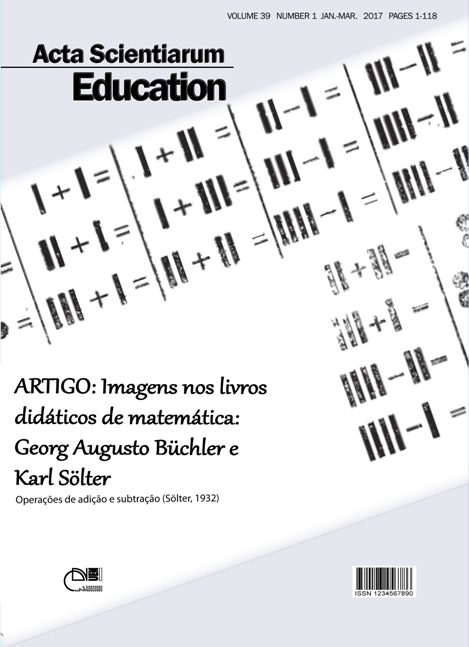
Images in textbooks of mathematics: Georg Augusto Büchler and Karl Sölter
DOI:
https://doi.org/10.4025/actascieduc.v39i1.28468Keywords:
arithmetic, image, intuitive learning, textbookAbstract
This article discusses the use of images in mathematics textbooks written by George Augusto Büchler and Karl Sölter, in a cultural historic perspective. Büchler´s first work, written in 1919, was aimed at the school public of school groups and German-Brazilian schools, while the second by Solter, published in 1932, was aimed at primary school. We conclude that the insertion of images in the two books analyzed, based on the intuitive method, had an instructional role but some of the images had ideological and aesthetic roles. Both authors included the images, more attractive to children's eyes, moving away from the abstraction so criticized by Pestalozzi and mathematical content presented in both books are focused on basic concepts of arithmetic, in a close connection between the child’s life and the child’s school life..
Downloads
Downloads
Published
Issue
Section
License

This work is licensed under a Creative Commons Attribution 4.0 International License.
DECLARATION OF ORIGINALITY AND COPYRIGHTS
I declare that this article is original and has not been submitted for publication in any other national or international journal, either in part or in its entirety.
The copyright belongs exclusively to the authors. The licensing rights used by the journal are the Creative Commons Attribution 4.0 (CC BY 4.0) license: sharing (copying and distributing the material in any medium or format) and adaptation (remixing, transforming, and building upon the material thus licensed for any purpose, including commercial purposes) are permitted.
It is recommended that you read this link for more information on the subject: providing credits and references correctly, among other crucial details for the proper use of the licensed material.


